The sustainability accelerator aims to co-create and scale solutions for climate and sustainability challenges globally. This request for proposals seeks to identify the first round of projects to be accelerated.
Stanford Global Studies (SGS) invites faculty and graduate students from schools, departments, and programs across Stanford University to submit proposals for Global Research Workshops.
Stanford Global Studies (SGS) invites proposals for Course Innovation Awards to support the development of courses focused on substantive topics of regional and global interest.
The Stanford Bio-X Interdisciplinary Initiatives Seed Grants Program awards provide seed funding for high-risk, high-reward collaborative proposals relating to human health.
Internal funding opportunity for Stanford Medicine faculty in all lines within seven years of first faculty appoinment. Open to women pursuing advancement or to men or women who support the advancement of women in medicine and/or medical research.
The Spectrum MedTech Pilot Program funds projects involving medical devices and mobile technologies used for (1) therapeutic applications and (2) device-based patient-specific (or POC) diagnostic applications.
The Stanford Alzheimer’s Disease Research Center (ADRC) at Stanford University School of Medicine is now accepting applications for a one to two-year Research Fellowship.
The IMA seeks to support research projects aimed at testing hypotheses in human subjects that, if validated, have the potential to pave the road to new medicines, vaccines and diagnostics or to enhanced clinical use of existing ones.
The Center for Precision Health and Integrated Diagnostics (PHIND), is soliciting new Precision Health Pilot Projects from new or established investigators.
The PHIND Center is soliciting the new Sanjiv Sam Gambhir – Philips Fellowship in Precision Health which supports postdoctoral researchers conducting investigations in the fields of radiology and precision health and medicine
The Office of Community Engagement is soliciting applications for Pilot Grants for Community-Engaged research projects. Projects must have a community engagement component. Research teams new to community-engaged research are encouraged to apply.
The Spectrum Population Health Sciences (PHS) pilot grants funds projects intended to stimulate novel research that can advance our understanding of how environments, policies and programs impact population health and social inequalities in health.
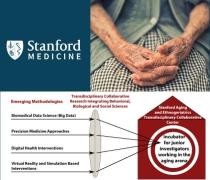
The SAGE Center aims to strengthen and diversify the aging research workforce and promote research advances using emerging methodologies focused on improving the health and well-being of diverse older adults.
The Changing Human Experience seeks proposals for its 2022 Humanities Seed Grants. These awards of up $50K support innovative and public-oriented faculty research in the humanities, qualitative social sciences, education, and law.
UCB Biopharmaceutical and Stanford University have established a multi-year collaborative partnership. The program is focused on digital health for predicting, preventing and curing disease.
The Human Performance Lab, an innovation hub of the Wu Tsai Human Performance Alliance, is seeking applications for research projects to optimize health and performance for all people across the lifespan.