The Stanford Alzheimer’s Disease Research Center (ADRC) at Stanford University School of Medicine is now accepting applications for a one to two-year Research Fellowship.
The Open Science Champion Prize seeks to recognize established faculty members who have led or significantly contributed to their field’s movement towards transparent and reproducible research practices.
The Open Science Innovator Prize is awarded to research trainees who have demonstrated a commitment to furthering transparent and reproducible science practices.
The PHIND Center is soliciting the new Sanjiv Sam Gambhir – Philips Fellowship in Precision Health which supports postdoctoral researchers conducting investigations in the fields of radiology and precision health and medicine
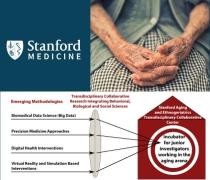
SAGE Center aims to diversify aging research workforce by mentoring researchers engaged in transdisciplinary research in ethnogeriatrics and promote research advances using methodologies focused on improving health & well-being of older adults.
SCI’s mission is to translate Stanford discoveries into individualized cancer care and prevention. In keeping with its goal of educating and empowering the next generation of cancer researchers, SCI offers funding to cancer research fellows.
The purpose of this grant is to support the development of curriculum materials focused on the ethics of community engagement. Instructors are invited to submit proposals of up to $6,000.
The WHSDM Center aims to promote basic & translational, clinical, and population health research on sex differences and women’s health at the School of Medicine, and to foster collaborations on these topics across SoM depts and the University.
The Haas Center welcomes proposals (up to $12,000) for new or revised academic courses for Winter, Spring or Summer quarters in 2021 that involve students in community engaged learning projects focused on racial justice.
This program is intended to complement and extend existing leave/sabbatical opportunities, providing 1-4 quarters of support for PI-eligible faculty for placements in public sector agencies and nonprofit organizations on problems of mutual interest
mediaX and the Stanford Transforming Learning Accelerator seek to fund research that can lead to new taxonomies and ontologies of personalization and differentiation in learning for individuals with special needs.
Collaborative projects with a hardware aspect related to enabling technology or devices for sensing, interfaces or flexible/stretchable electronics, worn or carried, or implanted in the body, or for uses in robotics, vehicles or structures.
SCI offers Innovation Awards to support collaborative projects focused on acceleration of basic, translational, clinical and population-based cancer research, and projects focused on cancer care, such as pancreatic, breast and gynecologic cancers.
The Neuroscience:Translate program supports translational research addressing unmet needs in any area of neuroscience. Resulting technologies and therapies are intended to lead to licensing exits from the university to eventually reach the patient
The King Center recognizes that conducting research in low- and middle-income countries is increasingly complex and that in extraordinary cases, faculty may have emergency funding needs for ongoing projects.
The Stanford MCHRI Uytengsu-Hamilton 22q11 Neuropsychiatry Research Awards Program aims to promote innovative, transdisciplinary research to improve the neurocognitive outcomes and behavioral symptoms of 22q11.2 Deletion Syndrome.
The Spectrum MedTech Pilot Program funds projects involving medical devices and mobile technologies used for (1) therapeutic applications and (2) device-based patient-specific (or POC) diagnostic applications.