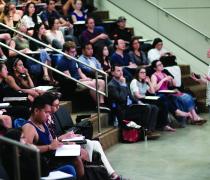
CTL offers quarterly teaching advancement grants of up to $2500 to Stanford instructors to support projects that directly enhance learning for Stanford students, with a particular emphasis on IDEAL goals.
Sarafan ChEM-H seeks to support small teams of clinicians and molecular scientists/engineers who seek to test bold hypotheses or validate the utility of a new tool in disease diagnosis or management using samples from human subjects.
Seed grants from $10,000 to $150,000, for up to two years, for interdisciplinary research projects that seek to promote new understanding of ocean processes and marine life, and to inform solutions for ocean health and sustainability.
SCI offers Innovation Awards to support collaborative projects focused on acceleration of basic, translational, clinical and population-based cancer research, and projects focused on cancer care, such as pancreatic, breast and gynecologic cancers.
The Innovative Medicines Accelerator seeks to accelerate the prototyping of innovative early-stage translational stem cell and gene therapies that address unmet clinical needs.
The WHSDM Center aims to promote health research on biological sex differences, women’s health, and sexual and gender minority health at the School of Medicine, and to foster collaborations on these topics across SoM depts and the University.
The Stanford MCHRI Uytengsu-Hamilton 22q11 Neuropsychiatry Research Awards Program aims to promote innovative, transdisciplinary research to improve the neurocognitive outcomes and behavioral symptoms of 22q11.2 Deletion Syndrome.
The Haas Center welcomes proposals (up to $12,000) for new or revised academic courses for Autumn, Winter, Spring quarters in 2022-23 that involve students in community engaged learning projects focused on racial justice.
Each October, the Stanford Associates Board of Governors selects grant recipients from proposals submitted by departments across campus seeking to engage alumni as volunteers and participants in new and innovative ways.